Writing from a Chromebook now. My laptop decided after working for a day that it wasn’t actually fine after its little shower, and now it won’t turn on. Since it was a ten-year-old MacBook Air, and I don’t have a lot of MacBook money, I’m probably going to follow Fran’s advice and build a desktop (make her help me build a desktop) to replace it. I also bought a wireless keyboard to go with my tablet in case I need a portable workstation. At least it’s lighter than a laptop.
This situation has made the week a bit stressful, so I haven’t done much heavy reading despite not having much work to do (clients are still on vacation). I did start rereading The Blue Sword (Robin McKinley), a comfort book from childhood, and am plugging through Cold Comfort Farm. I’ve also gotten a good bit done on VOID, and a little on a short story that might even turn out to be short. I swear I will learn to write short stories someday.
It’s almost August, which I personally consider the beginning of fall. The days are hot, but the light is changing. The nights are getting cool. If I open the windows (and lock the cats up so they won’t climb out on the roof), it feels like great weather for a night walk. Unfortunately, my neighborhood, though fine in daylight, isn’t really an “evening stroll” kind of locale. Instead, we started watching Jungle Cruise, which is reasonably entertaining.
On a different note: I have what I’m pretty sure is ADHD. I’ve never been screened for it, but I have most symptoms on every list I’ve ever seen. I saw this in a Facebook group the other day, and it really knocked me over.
Content credit Reddit user soozdreamz
So I’ve been a compulsive eater all my life, particularly of sweets. I could never stay away from them. If there were no sweets, I’d binge-eat whatever I could get. Most of my most shameful childhood memories revolve around stealing food. At parties, I always haunted the refreshment table. The food was always in the back of my mind: what looked like it tasted best, how soon I could eat it, how much I could take without looking greedy. I could never understand how other people could not eat when good things were on the table. It didn’t matter how full I was, or how ashamed of my appetite and belly; if something good was there to be eaten, I would eat it until I couldn’t eat anymore.
I never understood why I couldn’t control myself the way other people could. It was much worse when I was tired or stressed. On a bad day, I’d go to the shop and systematically collect everything that looked tasty, and then I’d sit down and eat through the entire pile. It was like a job I had to do. It didn’t even taste very good after the first minute, but I kept doing it.
So… this post really explained a lot for me. I’ve had people tell me I was eating because I was bored, eating because I was nervous, eating because I was tired. But I’ve never heard anyone tell me, “You’re eating because you’re low on dopamine. Every time you eat something tasty, that little burst of pleasure gives you a little chemical boost that builds up your initiative until you’re able to handle tasks again.” Again, I’ve never been screened for this, but I’ve been observing my eating habits over the past two days, and it really does seem to work that way. Maybe even my procrastination–the long stretches when I sit watching YouTube or reading fanfic or playing mobile games instead of starting on my projects–is a way of banking dopamine, gearing up for the quick bursts of hyperfocused work time when I’m actually able to get things done.
I don’t know. I’m not a psychiatrist. But it seems like a decent theory. I’ll play with it and let you know.
I’m having a quiet day today. Vacation season in Prague means I’m teaching a lot fewer lessons (I earn my bread and butter teaching English, mostly to children), so I’m enjoying a bit of a break.
I’ve been wanting to post here more regularly, but wasn’t sure what direction I wanted to take this. I had a writing blog a long time ago, but could never quite decide what I wanted to post there, and eventually abandoned it. (You can still see it here if you’re curious.) Author blogs are tricky if you’re not already a steady seller. You have to decide if your blog is for your readers or for other writers, and there’s not a lot of crossover between the two styles. Plus blogs aren’t quite as much a thing now as they were ten years ago. So I think this is just going to be whatever it wants to be, at least for now.
Today I’m doing a little of this and that. I resubmitted a short story that had been rejected, and decided to trunk another one that wasn’t doing well. Short stories are something I’ve been working on. Since I work in novel form (and not short novels, either), I have trouble fleshing out a character and delivering a strong plot within a few thousand words. I started a new piece last night with that thought in mind, and and it feels promising, but it also has the potential to become another monster. Oh, well. Monsters have their place.
I’m also working on my ongoing novel project, THE VOID AND THE RAVEN. This is going to be a real doorstopper of a book, and will probably be take years to complete. It’s high fantasy (if we can call it that with no elves) and I’m really enjoying writing it, but I do sometimes feel as if I’m painting a cathedral with a very small brush. It’s good to have a chunk of time to work on it.
Some inspiration:
-Competitive reality TV shows about art and design. I feel a little silly to be binging these, but it’s really satisfying to see professional artists being driven to create the best thing they can as efficiently as possible. So far I’ve seen one season each of Blown Away, Interior Design Masters, and Next in Fashion. (Many thanks to my girlfriend for letting me mooch off her Netflix account.)
–A Suitable Boy by Vikram Seth. I’m maybe a tenth of the way through this behemoth, but I love it so far I love it. It’s such beautiful writing that it really makes me want to elevate my craft. I wish I could carry it outside without needing a suitcase to carry it in.
So that’s Friday in Prague for me. How have you been lately?
She wakes on an altar, with words in a language she doesn’t know ringing in the air above her. She opens her eyes and looks up, sees a figure in white and black standing over her. He holds something in his hands: book, murmurs an awareness she didn’t have a moment ago. Book. Priest. Man. Church. For the echoing vault that stretches into shadows above them is surely a church, whatever that is, though she can feel that the building is cold and empty, closed for the night.
She identifies muscle groups one by one, takes control of them, gathers herself, and sits up. She is naked. Beneath her skin, the altar (marble, whispers that strange awareness) is unyielding and cold. Frowning, she pushes herself up off the slab and stumbles to the floor. The shock of the ice-cold stones beneath her feet wakes her for a moment, and she remembers that she is human.
Or something like a human. The echoes she hears are more resonant than they would be for human ears. She remembers the distinction from before.
But what was before?
She has lived other lives. This body is familiar: the height of her head above the ground, the length of her arms, the size and strength of her hands. She vaguely remembers using these hands to do… something. What was it? What did she do, here in this world, where the night is dark and cold? And why (she is sure of it now), why did it end so soon?
It’s too cold here. She doesn’t know why she has come back, when she was somewhere so much better. She can’t remember details, but drifting veils of memory she cannot grasp show light, warmth, happiness. Surely she does not want to be here.
Still, there is something poignantly charming about this realm of beating hearts and tumbled emotions. There’s joy here, mingled with the sadness, and other things you cannot see in brighter places, things that only shadows illuminate. She didn’t want to come here, but, if she is here, she may as well live awhile. There’s time enough to die, in the fullness of a mortal life. She need not yearn too much for heaven, when she’ll be back again so soon.
She hears a sound behind her: belated footsteps, as the man who called her back into this world moves to guide her through it. She knows him by his step before he comes into view.
“John.” Her voice emerges as if from a crypt. “Where are we?”
“Safe.” His voice is breathless. “You’re safe here. Are you feeling well? Are you…” He trails off.
She studies the man as her vision sharpens. She always knows John when she sees him, no matter how far he has wandered from the place where she saw him last or how much his face has changed. He’s decently handsome in this lifetime, in an everyday way, black-cassocked though there is no one here to see his priestly dress. Not too old, but not young. Experienced. He is the kind of man you feel you can trust.
Learned instinct, deep in her golden bones, makes her wary of the feeling.
“Alethea.” His voice shivers as he says her name. “Do you remember anything?”
She shakes her head slowly. “What happened? How did it end this time?”
He avoids her eyes. “Not well. But I think we’ll do better this time. Now that you’re here, we can talk about what went wrong.”
She is unsettled by a flash of resentment as she listens to his speech. Why should he look at her so expectantly? She has just awoken. How can he pin hopes on her so soon?
Memories brighten like constellations on the blackness of her mind. Where she was before, she didn’t need memories; she had more elegant ways to think. But these are the memories she had before, returning with all the other tired features of mortality: breath, heartbeat, and fragile brainwaves.
These flashes of life appear one by one and in clusters. Some are bright (morning sun glinting over high treetops) and others harder to perceive. There are snatches of conversations murmured in various languages, swift flashes of violence and wonder and grief. A man speaks above muttering crowds: something terrible is about to happen, something too big to stop. And John (brown-robed, gray-haired, humble and uncertain) stands in a corner, watching, as it all begins to happen.
He is always there, in every memory. He has been a part of every life she’s lived, every brief ill-fated facsimile of mortality she’s experienced. She can see him at all ages–in all ages–face after face, all different but all indefinably, undeniably him. Though he’s usually younger when he calls her back into existence. She wonders what’s kept him this time.
She blinks, disoriented, as her vision shifts back to the present moment. Beside her stands a different gray-haired man, in different robes, wearing the same furtive expression as before. He isn’t looking at her just now. Something in his own memories has made him ashamed, something he hopes Alethea won’t remember.
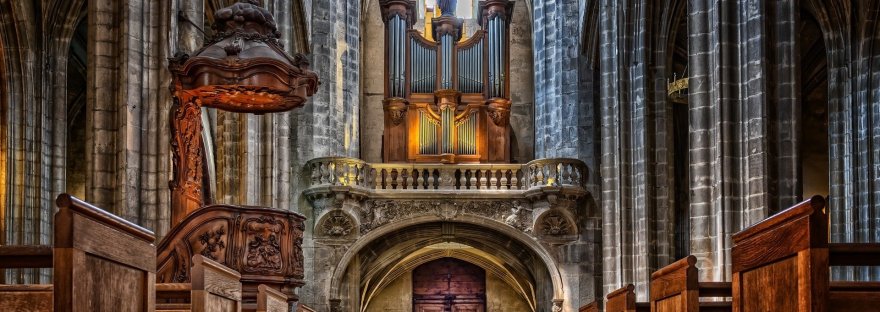
She tries to get her bearings by looking around at the empty church. It’s the kind of vaulted, high-spired building that was slipping out of fashion the last time she was alive. History has worn it down: the floor tiles are scuffed and pitted, and the varnish on the great sleeping pews is dark with age. But the walls are clean, unmarred by candle-soot, and the metalwork gleams.
Alethea walks down the aisle, putting distance between her and John. Light from strange, steady lamps half-illuminates the stained-glass windows, showing scenes from the lives of saints and martyrs. Why do churches hide the outside world with colored windows? Do they fear their congregations, once distracted, will leave their shepherd?
The air is cool, fragrant with incense. She has missed the scent. Wherever she has been, there was no incense.
She feels herself beginning to solidify, to settle into this restrictive new physical form. Against the surface of her mind she sees a sort of picture: a delicate insect unfurling wide, wet wings, newly emerged from its protective shell and nearly ready to sail on the world’s wind. She knows that she is like the butterfly’s wings: great in potential but not quite ready, not quite firm enough yet to face the world alone. She must wait just a little longer.
(…Quoth the Star, “And if they shall come to me, in the fulness of their trust like lambs to the shepherd, then I shall lead them beyond the gates of heaven into the country of gods…”)
She hears him come up behind her–that tread she’s known for dozens of lifetimes–and shivers at the sound. A rustle of fabric makes her turn: he offers her a robe. She takes it uneasily, slipping it over her shoulders.
“We’ve waited a long time for you.” He studies her with quiet satisfaction. “I tried to call you back more than once, but you never answered. I had to call again and again–it was almost like you didn’t want to come. I was almost ready to despair. But…” He smiles, and touches her cheek, pulling back sorrowfully when she flinches. “You’re here now. You’re safe. We can start again.”
Again she feels a flash of irritation. Why can he not let her breathe–let her simply live in this new world a moment, before he starts asking for things? Every heartbeat is so precious in these short lives. Can he not leave a few heartbeats for her alone?
“So you have a congregation?” says Alethea, concealing her annoyance. “How long did it take you to build one this time?”
John laughs. “Oh, decades. I took my time–I’ve learned my lesson. Of course, cult-building is safer these days. They don’t kill heretics anymore, at least in most places. But lives are longer now, and I thought I might invest my time in building something grander.” He gestures at the church, which must seat several hundred people when full. “We’re thousands strong now, and the core group is in its hundreds, all of them zealous. We await only you to guide us, O Star.”
They are speaking a language that is no longer spoken anywhere in the world. They always default to this tongue when they are alone together. It’s a comfort for them, a single remnant of the first world they knew.
As they speak, something of the present moment falls away. Alethea can imagine them as they first were several millennia back, when John (mispronouncing one of the names of God) suddenly found himself with a young Star seated on the clay altar of his humble shrine. He was father and brother and guardian to her then, in those first days when she could barely speak. She knew so little about the world then that any ill-intentioned person could have led her astray, and she trusted him absolutely.
It’s hard to remember that innocence now, with the weight of all their lives between them. A thousand years is nothing to a Star, but all her brief sojourns in the human world have made her sadder and more cynical.
She wonders, as she often wondered before, if John’s congregants can sense the tissue of his former lives hanging about him when they look at him. Do they ever guess what an uncanny thing he is: the everborn priest with his apocalyptic visions and his guiding star pulled ever-more-reluctantly back into life? And if they do know, are they frightened? Or only convinced that they have found the right mystic to follow?
She looks again at the church. It’s certain that John didn’t build it. He’s a visionary, in his way, but not a builder. His influence was always insidious, slipping into established movements and corrupting them from within. A story here, a small doctrinal edit there: he’d make these little changes until the faith was quite transformed, and then place himself as a minor leader and use the wedges he’d set in place to create a schism.
She wonders what faith he has corrupted this time: whether it’s the same one they knew before, changed for the era, or whether some wheel has turned and the faithful pray to different gods now. It doesn’t matter: John can make their doctrine fit in any setting.
However he got it, the church is well taken care of. Row upon row of candles burning above the altar illuminate a tile mosaic of a single blazing star. The altar is well-tended, its cloths expensive, and the candles are white and smooth: this world has moved beyond beeswax.
Alethea feels a strange sense of home. If she hasn’t been in this church before, then she’s been in many very similar ones. She trails her hand along the edges of the ancient pews, trying to remember the faces of the people who must have sat here, but her mind is blank. This is only a building, with a high ceiling and echoing walls. If she wants to see people–to know for sure what her place could be in this world–then she must start by getting out of here.
Looking for an exit, she notices for the first time that all the bright windows are similarly themed. There is a young woman, different in each scene, but always with a star floating above her head. In some pictures, she is speaking to seated crowds; in others, she performs miracles. A cliff shears from a mountainside. A forest catches fire. A child rises from a swollen river, lifted by unseen hands. Alethea remembers these small crises in soft, swift flickers like moments from a dream. How long it must have taken John to remember all the details of her many lives, to have these windows made. He seems to have made a saint of her: slipping her story into the lore of some great religion, duping the faithful into adding her to their canon.
She looks again for an exit, but all the doors are out of sight.
(…And the Star spake again, and her voice rang like the trembling of a mountain shaken by avalanche. And she called aloud to the people who had abandoned her, and in sorrowful tones did say, “The world is wicked, and the children of the Star are few in number. Long days may pass away before the gates of heaven should again open. I will pass away, for a time, into the country of gods where the people of the Earth cannot follow. But if my people are strong in faith, and wait with patient hearts and open minds, then I shall come again…”)
John has followed her gaze. “Aren’t they beautiful? They were made by one of my first converts, an artist I knew as a young man.” He smiles. “I was born into a good family this time. They encouraged me to study whatever I liked: art, religion, folklore… When I was still just a boy, I found one of our old hymns in a book of folk songs, and it all came rushing back.” He peers into Alethea’s face with undisguised eagerness. “Do you remember everything yet? Sometimes it doesn’t come back for you all at once. Tell me if you have any questions–I can help you to bring it back.”
Alethea has not remembered everything, but the most important memories are coming back. Still, something restrains her. “No. I don’t remember much at all.”
Disappointment slides behind his eyes, but he hides it quickly. “You’re the Star,” he says, “the chosen child of Heaven, come to Earth to lead humankind into the country of gods. You’ve lived a hundred lives before, and each time we get a little closer. This time… this time, Alethea, I think we may succeed.”
It’s all she can do to hide the visceral stab of revulsion his words inspire in her. No, says a voice as deep as her whole being. Not this time. Not after last time. No. Unsettled, she pulls away, and when he reaches for her arm she does not let him touch her.
He seems to sense that he has misstepped. “Things are better now,” he says. “It won’t be like last time.”
Ignoring him, Alethea walks to the nearest window, bare feet sure on the cool stone floor. She reaches out an unscarred hand to trace her fingers down leaded panes chilled by the autumn night wind outside. There is a picture in the glass: a woman, a man, a small flock of sheep. The tree above them holds secrets in its branches, and a flat blue sky presses down on them overheard. In the center of the sky is a large white star.
Alethea wants to see the sky–the real one, not this facsimile. If she can look into the vault with her own not-so-human eyes–look long enough, hard enough–then perhaps her gaze will pierce it, and someone beyond will condescend to give her a few answers. She wants out of here. Out of this. Out of all of it.
She feels the feather of John’s touch just brush the space beside her face. He’s always wanted to touch her more than she allowed. Did he dare, in those moments when she lay cold and breathless on the slab–did he dare then to touch what was not his? If she doesn’t repel him, will he try it again?
She will repel him. She has learned the technique, over time.
“What are you thinking of?” he says.
She doesn’t answer. Everything is echoing. Her breath comes back magnified by all those colored windows, all those breathless saints and martyrs reflecting her own dead selves. Time is catching up to her. The past, in all its ugliness, unfolds inside her head.
And then, at last, she remembers the last time she died.
They almost succeeded. John is right about that. Their sudden schism, their powerful second sect, rising without warning in a society sleepy with tradition, nearly upset the social order and set the Star at the head of its faithful. If they’d had a few more weeks, a few more months, to stir their followers to the necessary point of fervor (to the point of violence), then the Star might have led the world to its salvation. (Or to its damnation. John was always certain of Alethea’s holiness, but she herself is beginning to have doubts.)
In the end, their followers lacked the necessary physical courage, and Alethea and her miracles were ultimately insufficient. And in the end…
“They burned me,” she says quietly. “Did you know that? They tied me to a stake and piled the kindling up… The whole town was there. All our people were in the crowd. I kept thinking, surely someone will stop it. These people, who said they loved me–surely they’ll come forward and stop this, surely someone will let me go. But they lit the pyre…”
Flames roar against the wall of her memory. She remembers the crackle of the kindling, a forest of broken wood in flames around her. At first it was only warm, then hot. Smoke rose, infiltrating her eyes, her nose, her mouth, until there was nothing but smoke, no air to breathe. Then the fire caught the hem of her shift. For the first shocked moment, the smell of her own flesh charring was worse than the pain. Then the pain was much, much worse.
“It was the worst death I ever had,” she says, turning away. “I never dreamed anything could hurt so much.”
A hand falls on her shoulder. “You’re here again,” John says, frowning as she flinches, “alive and well. We weren’t quite as strong as we hoped, last time, but this time will be better. This time–“
“How many of them died?” she interrupts. “After I was gone, how many of the others did they kill?”
John lowers his head. “None. You know how it was in those days. They… were frightened. They wanted to protect themselves, protect their families. They all knew it was over when you died. So they…”
“They kept their heads down.” She watches him closely. “And you? Were you able to get away, or did they come for you after they’d killed me?”
John is too quiet. Alethea peers at him through the candle-dimness, and realizes: “You were there, in the crowd. You watched them do it.”
He raises pleading eyes to her. “Alethea. There was nothing left for us once you were gone. You are the key to Heaven, the heartstone of our faith. When our people saw you… lost… their faith went with you. It was all I could do to hide myself, to bear witness to your death and slip away to record it. With you gone… what else could I have done?”
“You could have fought for me,” she snaps, “as I always fought for you. Stood by me, as I’ve stood by you so many times… I gave my life for that cause you always said was so important. Could you not, just once, have given your life for me?”
For she remembers now that it always goes this way. Every time he brings her into the world, she stands and fights and dies for a new generation of his brave little movement. Other deaths, earlier but just as ugly, are floating into her mind: stoning, drowning, strangling, beating. Witch, they always said, as her powers frayed the world. Witch. Demon. Monster.
She draws harsh breaths of the incense-scented air, and feels that monstrous power begin to seep back into her chest.
John inhales sharply, as if something had raked its claws across his skin. Perhaps he, too, feels her power awakening–and covets it, as he always did. For who would try to call upon the name of God who did not covet a god’s power?
“Alethea.” His voice is faint. Perhaps he knows he’s already losing her. “Look around at how strong we are. Look–here’s your story!” He gives her a leather-bound book, fragile with age. “When I survived, I wrote your stories down. I saw them safely hidden and safely found. I taught your songs to likely children. I made parables of your truth and taught them to your enemies. With my life, I ensured that your story wouldn’t be forgotten. And now we can start from a position of such strength! Your people already know the tales. They’re only waiting for you.”
Alethea opens the book. Fine-printed scriptures blur past her eyes as she turns the pages, but her awakening power lets her read them at a glance.
…And the young Star, in her virtue, did call upon the people to be as gods, and to do as she did that they might learn her ways. And the faithful, heeding, did spend their days in searching after knowledge of the sky, and watching the workings of the sun and all her planets, until they knew the heavens as well as humankind may know them. And when they had thus watched for many days, the Star going down among them said…
…Now the Star, being weary, did make a place among the trees and lie down to sleep there. And she said unto her followers, “Come, and rest, and be not afraid.” But her followers did not trust, and did not stay; and they went instead to a nearby town, and found rooms there for the night. But on the morrow, when they returned to the grove of trees, they found the Star asleep, enclosed in a chamber of crystal that rang like a thousand bells…
…And the clergyman, going in among the trees, did happen upon a young woman who spoke to the earth as if it might listen. And when she had finished speaking, a spring of water did flow forth from the ground, and the woman did cup her hands and drink of it; and when she saw the clergyman among the trees, she did call unto him and say, “Come, and drink, and be refreshed.” But the clergyman, thinking that her power came from an evil source, did say unto her, “Witch, thou witch…”
…But being grieved by their faithlessness, the Star did bow her head and weep. And as she wept, she cried unto her followers, saying, “O, my beloved, o my treasured ones, why have ye no faith?” And the master of the town did take up his sword…
Reading the book, Alethea doesn’t recognize herself. The woman–the being–whose deeds are recorded here existed only in the head of the man recording them. The Star as she truly is could never be encompassed by ink and paper, certainly not in the hand of a man who sees her only as his instrument. If Alethea dies–and she will, sometime or other, and sooner if she follows John–then the world will never truly know the Star at all.
And who is she, really? Her mind holds a great emptiness at its center. She has many memories of her early lives, but they are all so full of John and his ideas that she herself is only a glittering shadow, devoid of character, notable only for her power. Of the place between death and life, where she was until a few minutes ago, she remembers almost nothing. She is a shell, not a woman at all, though she resembles one. If she lives another lifetime at the head of John’s “movement,” it will only be another story in his holy book, another incarnation of a saint. If she wants to know anything about herself, she’ll have to leave him.
She sets the book on the nearest pew. “John,” she says, “I can’t do it this time. I’ve been your sacrifice a hundred times. I’m not going to do it again.”
John looks pained. “You’re not a sacrifice. It’s not supposed to happen that way. It’s the world that does it. Not us. Not me.”
She shakes her head. “It doesn’t matter,” she says, though of course it does. “I’ve lived and died and lived and died so many times, and never seen more of the world than your fool’s campaign took me through. And I’ve stood by you in all my lifetimes, and never known another soul except as a potential convert. You’ve kept me so close, John, that I hardly know anything about this world, though you want me to lead it into some shining new era. I think I’m owed a lifetime or two to get a grasp on things.”
Anger flashes in his eyes–quickly hidden, but audible in his voice. “And who called you back,” he says tightly, “to live those lives again?”
She peers at him, surprised by his shallow pettiness, and realizes that he’s degrading. Time, and death, and disappointment have dulled the focus that once made him such a reckoning among priests. Once, his dream was to carry his flock into the heavens–to ensure their salvation through force of will, if that was what it took. Now he’s growing petulant. You can see in the twist of his lips that pride is as great a motivator for him as faith. He wants to be her priest. He wants to be her priest. He wants to usher in the new era where the world will be governed by the philosophical faithful. After all this time, all these lives, he feels that he has earned the right to guide the Star to victory.
(…Yet there were those among their number who in their pride had lost the spirit of their prayers; and though they wore the garb of the faithful, yet they had become her enemies…)
And because it is his pride that leads him now, he has lost the right to guide anyone at all.
It begins to be clear to her how terribly, terribly lonely he has been in the years–the lifetimes–when she was not in the world. His devotion to his faith has always been entire. No worldly things distracted him; he had few friends, few physical pleasures, and no social or political affairs to speak of. Art held no meaning for him where it did not further his cause. In her mind’s eye she can see him rising from his cold bed, dressing and eating alone, performing all his solitary rituals morning after morning and night after night. No one greeted him when he retired, alone and silent, to the darkness of his bed. If some rare spark of joy escaped a dream of heaven and lodged in his fading memory, he padded it carefully with doctrine and added it to his treasury of lore, its mystery rendered tame and soon forgotten.
In her mind’s eye, she can see the dark, quiet room where he sleeps alone, contemplating his life’s mission and all the names of God. His clothes smell of dust and incense. His skin is translucent. He has nothing to live for, or hope for, but her.
And now, though he hasn’t realized it yet, even that one hope is lost. There’s nothing holding her here, no bond of love or friendship. Death has washed clean that portion of her heart. If she were to meet this man on the street, she wouldn’t glance at him.
He is still speaking, unaware that her judgment has been passed. “Who brought you down to earth,” he says, “taught you to live among people, showed you the injustice you were born to right and the ignorance you were born to correct? What is the meaning of your life, without us to center and focus you? What purpose can your life have if you don’t know what you’re here for?”
“The same purpose as any life but yours,” says Alethea, “Mortals don’t know their life’s purpose when they come into this world. They’re born with nothing. If their lives have meaning, it’s meaning they’ve intuited or designed themselves. I’d like to see what I can make without you there to tell me what to think.”
With these few words, John’s shoulders slump. When he speaks again, his voice is defeated. “Please,” he says. “I beg you. Don’t leave all I’ve built here. I have given everything I am to bring you back. Every life I ever lived, I lived for you. We have a chance to do it right now, Alethea. You are so strong–you have so much potential. I know it will work this time–this will be the last.”
“It’s never going to be the last,” she says. “You’re not going to stop until you somehow die forever.” She regards him speculatively, wondering how she should deal with him. He is not strong. He’s allowed iterations of her to fight his battles for him for thousands of years. If she wanted to destroy him, there would be little he could do.
But there is still hope for him, perhaps, and so she only says, “I am not a saint, John, and you are not a prophet. Whatever you do with the rest of your lives, don’t call me back again.”
She takes off the robe he gave her, wraps it around her hand, and smashes her fist through the window.
The first pane breaks easily. Beyond the broken glass, a waning moon blazes in the ice-black sky. Its brightness steadies her: beyond this chapel, at least this one thing is real. The moon is no legend–and neither is she.
She moves to the next pane. John tries to stop her, but she bats him aside, her strength much more than human. She straightens the cloth on her bleeding hand and breaks another pane, and then another.
More slices of sky are revealed with every painful strike. The wind-swept night comes clearly into view, and below it a line of rustling trees and a quiet, orange-lit street. As they appear, the woman and the man and their flock of sheep are vanishing.
“Alethea,” John says. “Please don’t do this. You don’t have to do this. Please, leave me something…”
But if she leaves him something, then this will all happen again.
Systematically, she destroys the window, knocking away each chip of glass, each fragment of color, leaving only the leading strips behind. Shatterglass drifts grow beneath her feet. They cut her soles and slick the floor with blood. She feels the pain only distantly. She has other things to think about.
The highest panes of glass are out of her reach. For the first time in this new life, Alethea summons a miracle. A shiver of suggestion wells from her chest, and with a wave of her bloodied hand the other windowpanes shatter, falling from the window like icicles from a roof. Alethea doesn’t duck or flinch, knowing that her power will protect her. It is the first miracle of many: in this life, she will use them liberally.
When all the glass is gone, Alethea grips the leading strips in bloodsoaked hands and rips them from the window. Thus are the vague forms of her destiny destroyed, dismantled, discarded. With each soft clank of fallen metal, her resurrector’s groans grow softer. In the end, he is quiet.
“Don’t follow me,” she says softly. “It’s best if we stay apart. I’d rather not hurt you, but I will if I have to. Don’t follow, and don’t call me back again.”
John shakes his head morosely, so diminished as to be pitiable. “Please stay. How can I do anything without you?”
Disbelieving, Alethea indicates the centuries-old church. Her voice is more pitying than angry. “You have all the resources you need,” she says. “With all the lifetimes you’ve had, think of how you could have helped the world, if you’d only wanted to. You could have been a beacon.”
He shakes his head sullenly. “The world is beyond help,” he murmurs. “It can only be remade.”
He is only a little kind of villain, one who thinks he’s doing right. The most common and most dangerous kind, perhaps. Even if she never sees him again, she’ll face his kind many times in the world outside.
Time to get to work, then.
She waves her bloodied hand again, and all the other windows shatter, raining diamond dust onto the pitted floor. A third wave blows the candles out.
“Don’t follow me,” she says again. “If we ever meet again, we’re going to be enemies.” Then, naked and unafraid, Alethea steps barefoot through the shards and climbs out the empty window into the living night.
As she begins to walk away, she hears a soft sound in the desecrated chapel behind her: the delicate chink of glass shards being picked up and set in order.
You have never seen beauty like the sunlight shining through shop windows into this proliferation of color. Red glass bowls cast crimson parabolas across a white tablecloth. A cluster of blue wine bottles share the light between them, commingling their cobalt splendor. So brightly do the points of sunlight blaze in a large family of crystal balls that you remember stories about house fires started by unwatched refractions.
A row of prisms dance across the top edge of the front windows. You squint into their scattered rainbows. They seem to scatter memories, too: you can’t remember how you got here.
The shop is uncomfortably warm, and has a stale smell, as if no one has visited in a long time. You wonder where the owner is. It feels wrong to leave the place unattended, but you don’t want to stay. Though the air is still, the glass ornaments and bells that hang from the ceiling shiver as if in a soft wind. You think of ghosts. In Victorian times they would cover the mirrors when someone died so they couldn’t trap the dead. What might be trapped in this chaos of reflections?
You wander through the shop, dusting your hands across forests of art-glass swizzle sticks and animal figurines. A heap of round glass fishing floats (witch balls, they call them) occupies one corner. Tiffany lamps sprout from a table like psychedelic mushrooms. Another table is green: bottles, vases, gazing-globes, liquor glasses, opera glasses, ashtrays. Antique Christmas ornaments cover most of one wall. Below them are big crystal bowls filled with smaller items: beads, marbles, stained-glass nuggets.
You dig your hands into this clicking hoard and pick up a lump of yellow glass. In the sunlight, it reminds you of urine. You put it back and pick up a soda-blue marble. As you roll it in your hand, your mind supplies the taste of it: how it would clatter on your teeth, slide cool and slick across your tongue; how tempted you would be to swallow.
Dropping temptation back in the bowl, you return to the center of the shop. Something has changed, but you can’t pinpoint it. Then you look again, and see what was there from the beginning.
Against the far wall stands a tall wooden case, rough-built like a wartime coffin, its front a plate-glass window. Inside, a man stands sleeping. He is of no particular age or obvious character, but you shudder to see him. Somehow he stands upright without support, and you wonder if he is a wax figure or some kind of mannequin. You don’t know why he could be here. He doesn’t belong.
From a hook beside the case hangs a long iron hammer. It is dull and crudely made. It looks like something used to stun animals for slaughter. Like the man in the box, there is no reason for it to be here. Like the man in the box, it makes you shudder.
You are standing in the center aisle. Tables to your left and right hold trays of little things one might pick up. Your eye falls on a silver tea tray loaded with glass paperweights. Your fingers close around one clear orb with a blood-red flower blooming in the center. It’s heavy as a stone, and fits perfectly into the curve of your hand. You want to throw it more than you’ve ever wanted to do anything in your life.
When you look up at the man, his eyes are open. They fix on you, muddy and cruel. He grins.
The paperweight flies from your hand. The crash of glass through glass is as loud as the death of the world.
When the echoes clear, the man steps out of the case. He inhales loudly, sucking at the meager air. He takes up more than physical space. He lifts the iron hammer from its hook. It seems to fit perfectly into the curve of his hand.
“No.” Your voice shivers. “Don’t do it. Please.”
For a second, he is still. Danger stands poised, not yet loosed on the world. You feel that there is something you could say to stop what’s going to happen. But no words come to mind.
The moment passes. Rolling his shoulders, he steps forward with brutish boots, swinging the hammer, loosening his muscles. A flick of his arm smashes a tableful of figurines. Animal heads and broken ballerinas glitter in the air for an instant before they fall. Another blow obliterates the glass table they stood on.
He clears the next table with a careless backswing. Another wave of glass crashes to the floor. The base of a round bud vase rolls to your feet, glimmering like Eris’ apple.
You start to back away. You think of running, but know you won’t reach the door in time. He is grinning, still grinning, anticipating the moment when there is no glass and only you remain.
“Stop,” you say. Your voice doesn’t make much noise now.
He swings high, smashing chandeliers, breaking bells and sweet glass chimes. Glittering shrapnel stings your brow and cheeks. You close your eyes, but the crashing of his hammer only magnifies when you don’t watch him. When you open your eyes, the shop is gone.
You stand in a waste of shards and powder. Glass dust hangs in the air. Fragments of it are trapped in the creases of your eyelids. Soon you’ll blink, and they will fall into your eyes.
The man rolls his shoulders, breathing heavily. Beneath his shaggy, glass-flecked hair, his eyes are unreadable. You open your mouth for one last plea, but your throat will not contract. Your muscles lock up one by one, leaving you frozen, unable to run, unable to fall.
As he lifts his hammer for the final blow, you look down and see that you are made of glass.
I’ve wanted to be an author since I knew what authors were.
I write fantasy almost exclusively. I’m heavily influenced by witchcraft, fairy tales, and the books I read growing up in the 90s.
I live in Prague, Czech Republic. Before that, I spent most of my adult life (more than ten years in all) working as an English instructor in South Korea. I’m from the USA (where my family still lives) and grew up mostly in North Carolina.
I have two cats and a cute girlfriend. I want more tattoos.









 Katherine Traylor