Hello, all! Here’s one more interview with another contributor to our collaborative anthology, Allegra Gulino. Remember, The Ceaseless Way: An Anthology of Wanderers’ Tales is still on sale in paperback for a few more days, so if you’re looking for something to read while you’re home for the holidays, this is a great time to check it out! The paperback version is available here, and the ebook version can be found on a number of platforms here. (If you want to learn more about our collaboration group, Wandering Grove Press, you can join our Facebook group here or follow us on Bluesky here.)
If you missed my previous interviews with Fraser Sherman and Ada Milenkovic Brown, you can check them out here and here.
1. Do you think your two stories are a good representation of your usual style and subject matter? Is there anything about them that’s unusual for you?
My stories in Ceaseless Way are a good representation of my usual style and subject matter because they’re excerpts from my novel, Monsters Unbound, which I’ve been working on for about two years. This project has become my world, and its tone is a culmination of a lot of my previous work.
2. What’s one style or plot element you’d like to “steal” from another contributor?
If I were to ‘steal’ from any other contributor here – which I don’t condone doing – I’d probably take Ada Milenkovic Brown’s folkloric elements, Fraser Sherman’s brevity and quick action, Katherine Trayler’s dreamy atmosphere, Rich Matrunick’s sense of peril, Secily Sluker’s metaphysical vision and Arden Brook’s whimsey.
3. Are there any anthologies or collections you’ve really enjoyed reading lately?
I recently subscribed to the classic Fantasy and Science-Fiction magazine. While it’s not officially an anthology, its collection of short stories, one or two poems and a few pages of book reviews do feel like one. So far, I’ve enjoyed diving into a diverse variety of writing styles, genres and themes within its pages (yes, it’s a physical magazine). I always find tales to admire, be intrigued by and sometimes, to figure out – I’m not the best at parsing hard Science-Fiction.
4. What writers have had the greatest influence on you throughout your writing journey?
There are a plethora of author influences for me, starting with YA classics, The Lion, The Witch and The Wardrobe series by C.S. Lewis, and A Wrinkle In Time trilogy by Madeline L’Engle. I cannot remember which came first, those two, or when I picked up J.R.R. Tolkien’s The Hobbit, but I was instantly hooked by the wonderful journeys that all three authors illustrate. In High School, I fell in love with Frank Herbert’s Dune series, and Stephen R. Donaldson’s Chronicles of Thomas Covenant. In class I was awed by Flowers for Algernon by Daniel Keyes, A Separate Peace by John Knowles and Jayne Eyre by Charlotte Bronte. In college, my English Literature major steered me toward classical literature. I came to favor the works of Virginia Woolf, William Faulkner, Lawrence Sterne, William Blake, John Donne, Emily Dickinson, James Joyce and D.H. Lawrence. More recently, I’ve come to love Ursula Le Guin, Emile Zola, Salman Rushdie, Margaret Atwood, Thomas Pynchon, and Marcel Proust. Over the years I’ve learned about writing craft (and continue to do so) and also about the attributes that I admire in books, so my reading standards have risen. Though my writing is grouped under the umbrella of Speculative Fiction, I’ve always read widely.
5. What is your editing process like? How long does it take you to bring a story from start to finish?
I edit while I write, instead of throwing the words down quickly and then going back to edit. This is because when I write, my vision for the scene is keen – I feel a sense of urgency about getting it as close to how I picture it as possible before I move on to the next section. Therefore, I’m not a fast writer, so focusing on daily word counts would only frustrate me because they’re usually not very high. I spend lots of time refining and reworking, not just on typing more words, However, once I’m satisfied with a chapter or section of the piece – it’s very polished and I don’t need to revisit it often. Then I can tackle what comes next.
6. Do you have any hobbies that aren’t related to reading or writing?
I love to sing – usually karaoke singing, though I was a community choir member for twelve years. I also love music and to dance – nothing professional. I frequently perform at No Shame Theatre events. Aside from that, I’m a consummate lap swimmer and gym goer. I also love to hike and to travel. When not out and about, I enjoy staying at our home in the woods, by a creek, where I give attention to our three darling rescue cats, a sixty gallon aquarium, house plants and garden. |
7. Are there any songs or pieces of artwork that capture the “vibe” of your stories (or of other stories in the anthology)?
I have a playlist that I’ve used for writing Monsters Unbound. It’s instrumental music from classics like Mozart, Franz Liszt, Beethovan, Chopin and Vivaldi, to more recent composers such as Satie, Leonard Bernstein and Leos Janacek, Igor Stravinsky. I also enjoy global pieces from South America, Africa, India, Romani culture and so on. I love composers like Andreas Vollenweider or the Silk Road Ensemble, that have multicultural instruments, rhythms and tunes. That playlist also includes soundtracks, from Bram Stoker’s Dracula, to Merchant and Ivory films, to Frida, to the Lord of the Rings and the Hannibal series. I love music that takes me on a journey, full of pathos, drama, or tenderness, but usually with at least a hint of darkness.
8. Are there any real-world places that inspired your two stories?
Absolutely, for Monsters Unbound. To inform and inspire my book, we went to Romania for two weeks last summer to collect information, imbibe atmospheres and explore historical sites. It was a fantastic trip and I want to go back! However, while my two stories in Ceaseless Way are set in real places – environments that I researched – they are not specific locations within that backdrop.
9. What would be the ideal place and time to enjoy each of your stories? What snacks and drinks would pair well with your stories?
A fascinating question. For Demon, He Called Me, it would add to the atmosphere if you could read it on a dock, by a river or on a boat, so you can hear the water lapping. As far as what to eat, I have two suggestions. The more luxurious would be a caramel/chocolate confection with sea salt, and a port wine. Or a nitty gritty option – sardines or anchovies and water to drink. For The Ortega Wolves Migrate North, some good Mexican fare, like pozole or chalupas, with sangria, consumed in a desert environment or at least near some cacti in a sunroom.
Thank you, Allegra! Happy holidays, everyone. I hope these interviews have inspired you to check out the book! : )
Cover image by GetCovers; original cover concept by Arden Brooks.
Hello, all! Here’s another long-belated publicity post for our new collaborative anthology (The Ceaseless Way: An Anthology of Wanderers’ Tales). This week, contributor Ada Milenkovic Brown talks about her two stories in the anthology and what led her to write them.
Again, if you’re interested in picking up a copy of this book, this is a great week to do so. The paperback version will remain on sale for $9.99 USD until January (at which point it will return to the normal price of $12.99). If you prefer ebook, it’s available on a number of platforms for $5.99 and will remain at that price. If you want to learn more about our collaboration group, Wandering Grove Press, you can join our Facebook group here or follow us on Bluesky here.
If you missed my previous interview with Fraser Sherman, you can check it out here. One more interview with contributor Allegra Gulino should be up in a couple of days.
(Ada also interviewed me, Fraser, and Allegra for this promotional mini-tour, so please check out those interviews as well!)
Do you think your two stories are a good representation of your usual style and subject matter? Is there anything about them that’s unusual for you?
I think In Valleys is absolutely spot on the sort of thing I usually write, including the love story elements.
I was actually intending to write something more fantasy based for my Bigfoot story, Nnn’s Children, but it just came out more realistically than I expected. Other than that, it is my style to write as plausibly as possible within the framework of the story world. So maybe it is in my usual style too.
What’s one style or plot element you’d like to “steal” from another contributor?
If I could bottle Rich Matrunick’s tone/mood/voice in Fading, I would bathe in it, metaphorically speaking. Other than that, I envy everyone else’s apparent ease with getting their stories to arc in a satisfying way. It is so so hard for me to find that in the initial stages of writing my fiction.
Are there any anthologies or collections you’ve really enjoyed reading lately?
I loved and learned a lot about what makes stories work from Charlie Jane Anders’ collection Ever Greater Mistakes.
What writers have had the greatest influence on you throughout your writing journey?
When it comes to writers I’ve read, it’s Zenna Henderson, Ray Bradbury, N. K. Jemisin, and Jeffrey Ford. I would say the writers who’ve had the greatest influence on me as teachers were Octavia Butler, Andy Duncan, Walter Jon Williams, and Nancy Kress.
What is your editing process like? How long does it take you to bring a story from start to finish?
Sometimes it takes me weeks, sometimes it takes me years. For the regular editing, I just pick away at it, like a painter adding a dab of paint here and there, until I can make it different, but I can’t make it better. My real pitfall is plot holes and endings. These are what take me a long time sometimes to find the inspiration to realize where the story needs to go. But I’ve gotten better at that over the years.
Do you have any hobbies that aren’t related to reading or writing?
Singing. I’m a lyric soprano and have sung solos in performances with choirs and at weddings and funerals. I tend to get asked to sing more funerals than weddings. I don’t know what that says.
I’m also an oboist.
Acting, although a case could be made that figuring out how to portray a character onstage is very akin to writing a character.
Hiking and cycling, but I sometimes get story ideas while I’m moving around out in nature, so maybe that’s related to writing too.
I do origami to relax.
Are there any songs or pieces of artwork that capture the “vibe” of your stories (or of other stories in the anthology)?
I vibe with surrealist paintings for the most part, such as: Paul Delvaux’s The Village of the Mermaids and just about any painting by Leonora Carrington. In fact, Leonora Carrington’s work could fit with our entire anthology.
Are there any real-world places that inspired your two stories?
Because five of my published stories take place in particular spots in North Carolina, I decided to continue writing a collection made up entirely of stories based in particular places in that state (where I live). Littleton, NC and Medoc Mountain State Park nearby have had Bigfoot sightings, and that is why I wrote a Bigfoot story set in that locale.
Although the medieval village in my In Valleys story is fictional, the original 1860 story it’s based on mentions a nearby village that does exist. It was my discovery that the nearby village was in East Germany near the (Communist period) wall that triggered the ideas for In Valleys Where Eternities Lie.
What would be the ideal place and time to enjoy each of your stories? What snacks and drinks would pair well with your stories?
There’s never a bad time to read. But otherwise, good lighting and a comfy chair, sofa, bed. Although I think readers might feel an extra resonance if they read Nnn’s Children outside, say under a shady tree.
Apples figure into both of my stories, so maybe readers should eat an apple when they read them. Otherwise, I usually like having a glass of wine when I read.
Thank you, Ada, for your interview (and for your amazing leadership in getting the contracts hammered out!). Tune in soon for one more interview and a bit more information about the anthology from my perspective.
Cover image by GetCovers; original cover concept by Arden Brooks. Headshot by/of Ada Milenkovic Brown. Apple tree image by kiyu_01.
Hello, all! I’m happy to report that after three years, our collaborative anthology, The Ceaseless Way, is now on sale in ebook and paperback formats. A lot of work has gone into this project, and though there have been bumps in the road, we’re really proud of the project we came out with.
This is a speculative fiction anthology (mostly science fiction and fantasy, with a little bit of horror), and each of the participating writers contributed two stories. Besides myself, the writers involved are Fraser Sherman, Ada Milenkovic Brown, Secily Luker, Allegra Gulino, Arden Brooks, and Rich Matrunick. “Wandering Grove Press” is the name we’ve given to what’s essentially an online writing co-op. The book is self-published, but a lot of time and work went into it.
The paperback version will be on sale for $9.99 until the new year, at which point it will go up to $12.99, so if you’re interested in purchasing a hard copy this is the best time to do it. The ebook version will remain at $5.99. If you’d like to follow our group for updates, you can find us on Facebook here or on Bluesky here.
I’m a little behind on my publicity posts, but check this space for the next couple of weeks for interviews with some fellow authors and a couple of insights into my own stories in the antho, “We Go Hiking” and “Jenny and the Fairy Queen.”
Cover image by GetCovers; original cover concept by Arden Brooks.
Hello! Sorry to have left you hanging for months and months. I’m not great at blogging regularly, but I guess you know that by now.
Here’s what I’ve been up to lately:
My largest ongoing project (besides my ever-in-progress fantasy series THE VOID AND THE RAVEN) is a collection of ghost stories, tentatively titled HAUNTED HOUSES. This is a long-term project I’m hoping to finish and self-publish in the next five years, or possibly sooner if I’m able. It will include new editions of older stories like “Wake Your Ghost” (which you can read here) and “Spirits in the Dark” (a novelette first published by JMS Books, which unfortunately didn’t get much attention although I was really fond of it). I also hope to include stories like “The Angel,” which you can currently see in Literally Dead: Tales of Holiday Hauntings by Alienhead press, and about fifteen other stories now in various stages of development. I’m currently editing another novelette called “The Woman at the Top of the Stairs,” which is a gothic romance story set in Prague, and hope to start sending it out soon.
On the subject of publications, I have an announcement to make! A very cool new magazine called Baubles from Bones has chosen my story “The Feast of the Changes” for publication in its inaugural issue. “Feast,” inspired by Where the Wild Things Are, is a soft, dreamy fantasy story about a boy traveling the world with his best friend: a large, furry monster. I had a great time writing it, and I’m really happy that it found a home with this venue. You can read the magazine (or purchase a copy) here.
There’s one more project I wanted to let you know about: some friends and I are putting an anthology together. It’s a collaborative project on the theme of “Journeys,” and it’s been in the works for a few years now. Everyone involved is a writer friend and occasional critique partner (including several from the Durham Writers’ Group), and all of us write speculative fiction of one stripe or another. Since late 2020, we’ve been batting things back and forth on Discord, deciding the anthology’s theme and parameters and editing each other’s contributions. Given that coordinating with other writers is like herding cats under the best of circumstances, and adding the specific complications of having to play chat-tag across disparate time zones, we had some trouble keeping things going, and there’s been a lot of trial and error involved in this process. But we’ve kept going, and we’re almost finished, and we’re pretty excited about it.
We’re hoping to publish the anthology in September. It will probably be released as an ebook first and then in hard copy. I’ll let you know about preorders as soon as they’re available. If you’d like to receive updates, you can join our Facebook group here.
Contributor Allegra Gulino has also created a Facebook page where you can see promotional artwork she’s created for this project.
We’re really looking forward to telling you more about this project as we get closer to publication time. In the meantime, thank you for tuning in, and have a great month!
In late October, Fran and I went to the US with her mom and two cousins for our wedding, which was held at the home of my mom and stepfather with a lot of our friends and family attending. We had a wonderful time and are really happy. I wish more of Fran’s family could have been with us, but we’re hoping to go to Sicily as soon as possible and have a reception with her friends and family there.
So… what haven’t I talked about while I was shopping and making moodboards?
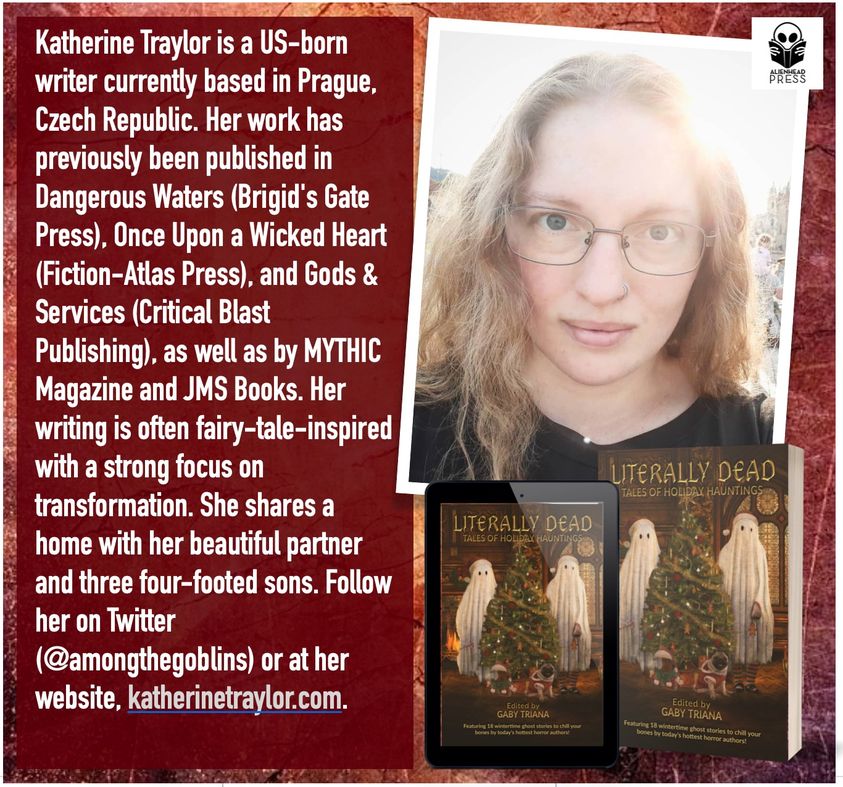
The main thing is that I have another anthology publication to announce! Very belatedly, too. My story “The Angel” appeared in Literally Dead: Tales of Holiday Hauntings, edited by Gaby Triana and published by Alienhead Press. The book came out in late September (sorry, I was busy! see above) and can be purchased in paperback or Kindle edition here.
This is a horror anthology, but I did not have my horror boots on while I was writing this piece. My story features a lingering ghost who doesn’t approve of a family member’s life choices and starts to make problems around the holidays. A reader close to me described the tone as “warm.” But I loved writing it, and I hope you’ll love it, too.
Look, it’s me! I feel very professional.
By the way, I mentioned this before but didn’t give you a link: another of my stories, “Sea People,” was recently published in the anthology Fish Gather to Listen by Horns & Rattles Press.
This is a horror anthology based around the sea, and my story is a slightly futuristic flash piece set in a seaside town. I’d love it if you’d check it out. I haven’t quite gotten through all the other stories, but the ones I’ve read have been terrific.
Have a lovely weekend, and dream of ghosts and spooky things–
Hello! I’m happy to announce that my new flash piece “Sea People” has been accepted for publication in Fish Gather to Listen, an upcoming horror anthology by Horns & Rattles Press.
The book will be out quite soon (maybe as soon as August), but there’s a Kickstarter in progress with stretch goals to make it extra fancy. Check it out, and I hope you’ll check out the anthology when it’s published. : )
I’ve been listening much more to Spotify lately. What’s most fun for me is making playlists, which reminds me of burning mix CDs when I was in college. Here’s one I made of songs that felt longing or wistful, including a lot of old favorites and others that just came up on shuffle.
I’ve been submitting a lot of stories lately, which slowed down progress on my novel but was a lot of fun. For some reason there’s a big market currently for short stories about evil mermaids, so I’ve written three in the last few months. One of them, “In the Nevergo,” was recently published in Dangerous Waters: Deadly Women of the Sea, an entire anthology of evil mermaid tales I was delighted to take part in. The others were a bit different in subject matter, and I hope to tell you more about them later.
I’ve also been dipping my toe back into poetry in the last year or so, with mixed results. I used to write poems quite a lot in high school, but they were very strange and I never shared them with anyone. Lately I wrote sets of poems for two different calls for submissions. None of them were accepted, but I’ll keep practicing.
Here are some very strange ones I’d forgotten I wrote last year. The project was called “The Unquiet Nursery,” with the idea being that each poem would be structurally based on a famous nursery rhyme but have much darker subject matter. About half of them were terrible, but I kind of liked these. I wonder if you can guess which nursery rhymes they’re based on.
1 I am not going to sleep. The lines have gone too deep. There’s whispering sin Upon my skin And something is starting to weep.
2 My little love Is up above, Pretending she is an angel. But in her wings, Unholy things Are burning like a candle.
3 My little dumpling Really is something, Sunning herself to sleep. She cannot be killed She cannot be held She only can rattle and weep.
4 Go to school, Little fool. See what they do Before they come for you. They’ll take your home and they’ll take your lands, They’ll crush your heart and they’ll cut off your hands. The strongest house is the one that stands, So go to school.
5 Something in the atmosphere Has made me very cold. The sun is full of cinders And the stars have all been sold. I cannot look away from it. I cannot break the spell That echoes in the twilight Like the tolling of a bell.
6 Into the dark! Into the night! Sing with the nightingales! Drink delight!
Out of the dark. Back from the night. Gone are the nightingales. All is quiet.
7 Mary Artless, Vain and heartless, How did you sink so low? The sons you should have cared about Are running like wolves in the snow.
8 First comes the matter of the monster, Next comes the matter of the nun, Then comes the matter of the long walk Into the valley of the sun, And last is the matter of the silver star And how the world was won.
9 Pretty little Mabel, Sitting at the table, Softly tells me, “Life is like a fable. But I don’t know the lesson I was meant to learn When I left my homeland, Never to return.”
I guess they’re basically doggerel. But so are the originals they’re based on. Anyway, it was fun writing them.
One more thing to tell you about: I have an upcoming publication in a friend’s anthology! My friend Sonya Lano has been working tirelessly on Slightly Sweetly, Slightly Creepy, an anthology of gothic romance, and the book will be out on April 29. My story, “The Wind Chimes,” is probably more “romantic gothic” than “gothic romance,” but I had a lot of fun writing it. The book is available for preorder here, and I’d love it if you checked it out.
Lots of love to all of you. I hope you’re doing well.
I’m working on a short story for an anthology my friend Sonya is putting together. It involves murder, ghosts and other spirits, romance, wind chimes, and a dark forest. I hope you’ll enjoy it when it comes out.
Anthologies are difficult in general. Some other friends and I were trying to put one together, but more than a year on it’s still in limbo because it was so difficult to allocate responsibility. I’m really proud of two stories of mine that were published in recentanthologies, but I’m not sure how they were received because neither book has gotten very many reviews. It can be a little discouraging. But then I realize that I myself haven’t read that many anthologies recently–I haven’t even finished reading the ones I was published in. So maybe everyone’s just busy.
Anyway, anthologies are an incredible way to discover new authors, and I haven’t been doing enough reading lately. Are there any collections you’d recommend?
On a completely different subject, I realized last night that the publication of “In the Nevergo” qualified me for an “Affiliate Writer” membership in the Horror Writers’ Association. I applied and was accepted today. I have a few more dark fantasy pieces in the works, so I’m hopeful that I might be able to upgrade to an “Active Writer” (i.e. full) membership before too long. I’ll see if there’s a badge or something I can put on my website. There aren’t a lot of concrete benefits to joining writers’ associations at this point in my career, but it’s a nice boost in a field where it’s hard to feel like a working professional.
(***I just checked and saw that under the updated membership requirements I also qualify for an Associate Membership in SFWA. I’m not quite ready to pay two sets of dues, though, so I’ll keep working towards a full membership there for now.)
I wrote this during a mini writers’ retreat with my friend Brittany Harrison back in 2010. We’d decided to do a Frankenstein-style writing challenge, since it was spooky season and our isolated rental cabin in the Smoky Mountains of North Carolina was very conducive to imagining horrors. When I decided to put out a few short stories as an ebook a couple of years later, this was one of the ones I included. I think I’ve grown quite a lot as a writer, and I wouldn’t call this representative of my writing now, but people have enjoyed it and I think it has some good moments. Let me know what you think!
“But you said I could go!”
“I said you could go if you kept your grades up, young lady, and I told you what would happen if you didn’t.”
“But Aunt Laurie–”
Adie’s mother folded the report card and set it down on the pristine kitchen counter. She clearly would rather have thrown it on the floor. “I will call Aunt Laurie myself and tell her why you’re not coming,” she said. “Or you can explain to her why shopping with your friends was so much more important to you than your visit next month.”
“That’s not–”
“Don’tyou raise your voice to me, young lady, or you’ll regret it.” Her mother pointed out the door. “Now go upstairs and do your homework. Dinner’s in an hour.”
Adie glared. “I’m not hungry.” Her stomach rumbled as she spoke. The air was heavy with the aromas of baking bread and homemade tomato sauce, and she hadn’t eaten anything since lunch. But some things were more important than her mother’s spaghetti, and New York was one of them.
Adie’s mother looked heavenward, took a deep breath, and let it out slowly. “All right. Then go upstairs and go to bed. I don’t want to see you until morning.” With that she turned back to the cutting board and began dicing celery with harsh, uneven strokes. Adie knew that the conversation was over. She grabbed her backpack and stormed from the kitchen, down the hallway and up the towering stairs. She made sure to stomp hard on each beige-carpeted step. When her mother didn’t come out and yell at her, she stomped even harder. All right, she would go to bed– and then she’d get up early tomorrow, eat breakfast and leave the house before either of her parents woke up. Right now she wasn’t sure if she wanted to see them ever again.
The trip to New York was a long-delayed birthday present from her Aunt Laurie, who had been one of Adie’s dearest companions until she’d moved away last fall. The thought of calling to tell her aunt that the trip was off was enough to make her gut clench. Tears blurred her vision as she opened her bedroom door. She threw her backpack on the floor, then went down the potpourri-scented hallway to the bathroom to brush her teeth. She would go to bed. Right now she’d rather be dead than face the knowledge that her own stupidity had lost her New York.
In the bathroom, Adie squeezed a healthy glob of toothpaste onto her toothbrush and shoved it into her mouth. She winced as it rammed the backs of her gums and bruised the inside of her cheek. As she brushed (tops… bottoms… insides… outsides… twice all over…) she watched the reflection of her face in the mirror.
The girl in the mirror was an unfashionable sixteen. She had frizzy hair and an awkward nose, and her shirt was stained from a spill at lunch.. Her cheeks were wet with tears; her eyes were red and swollen. This was the kind of face you had when you were hopeless. When you weren’t going anywhere. When you would spend Christmas break alone with your own stupid parents… and when, worst of all, you weren’t going to New York because you were stupid.
She spat her toothpaste into the sink, then spat again to clear the remnants from her mouth. Now the girl in the mirror had little dribbles of toothpaste foam all over her lips and chin. Her nose had begun to run. She looked ridiculous.
Adie wrapped her arms around herself and stood staring at the girl in abject misery. So stupid. Why had she ever even thought she would make it to New York? She was probably doomed to stay here and rot, like an unharvested pumpkin in the world’s worst field.
A little more toothpaste ran down the chin of the girl in the mirror. Despite her foolish appearance, there was a glint in her eyes that Adie didn’t much like. She looked mocking. Mean. She could understand why people wouldn’t want to be around a girl like that. She wouldn’t want to be around herself, either. She just made everyone angry. It was probably for the best that she wasn’t going– Aunt Laurie would probably have regretted inviting her even if she’d gone.
Adie glared at the girl, and the girl glared back. “Fuck you,” Adie whispered. She wiped the toothpaste from her mouth with an angry fist.
The girl in the mirror watched her dumbly, as if she hadn’t understood what she’d said.
On a whim, Adie licked a fingertip and wrote– in big, neat block letters– on the surface of the mirror: FUCK YOU.
Then, to make it even clearer, she wrote it backwards.
When she looked back at her reflection, her stomach dropped. The girl was not looking at her. She was looking at the message Adie had written, and her lips moved as she read the words. When she’d finished, her eyes widened. Slowly, she lowered her eyes to stare at Adie.
It was not a nice look.
More than an hour later, as Adie lay shivering in bed with the blankets over her head, her mother came into her room. She knew that it was probably her mother because she could smell her mother’s neat floral perfume over the faint tang of her own unwashed laundry. Well-pressed chinos swished efficiently to the center of the floor and stopped.
The woman who was probably her mother stood quietly for a long time. Adie lay in the warm darkness under her blankets and wished that she could be sure. “Still mad?” her mother said finally. The sound of her voice was blessedly familiar.
Adie shrugged. She hadn’t actually thought much about the argument since seeing what must have been a hallucination in the bathroom mirror. She still shuddered just to think of the malice in her reflection’s eyes.
“Do you want to talk about it?” her mother continued in her calm, reasonable way.
Adie snorted. Tell her mother she was hallucinating? Sure, that would smooth things over.
Her mother sighed. It was a soft, gusty sigh, quite restrained: the sigh of someone who has too many troubles to welcome another one. There was also that extra trill of exasperation at the end that had always been reserved for Adie. That, more than anything, convinced her that it was safe to come out.
Adie pulled the covers from her face and sat up. The air was a cool shock against her face after more than an hour between the blankets. Her mother, who had already started to leave, stopped in midstride, looking surprised. Adie didn’t usually get out of a sulk until at least a day after she’d started it.
“Still mad,” she said quickly, lest her mother wrongly assume that all was forgiven. “But I’ll… I’ll come downstairs.”
“All right,” her mother said, looking bemused. “Go wash your hands and then come set the table.”
Adie approached the door to the bathroom as if it were a dragon’s cave. Her heart was pounding. The light was out, and since the room had no windows it was as dark as a real dragon’s cave would have been. Adie snaked her arm around the doorframe and felt for the switch. For a harrowing second she was sure that something would bite her hand off, but then she found the switch and light flooded the bathroom.
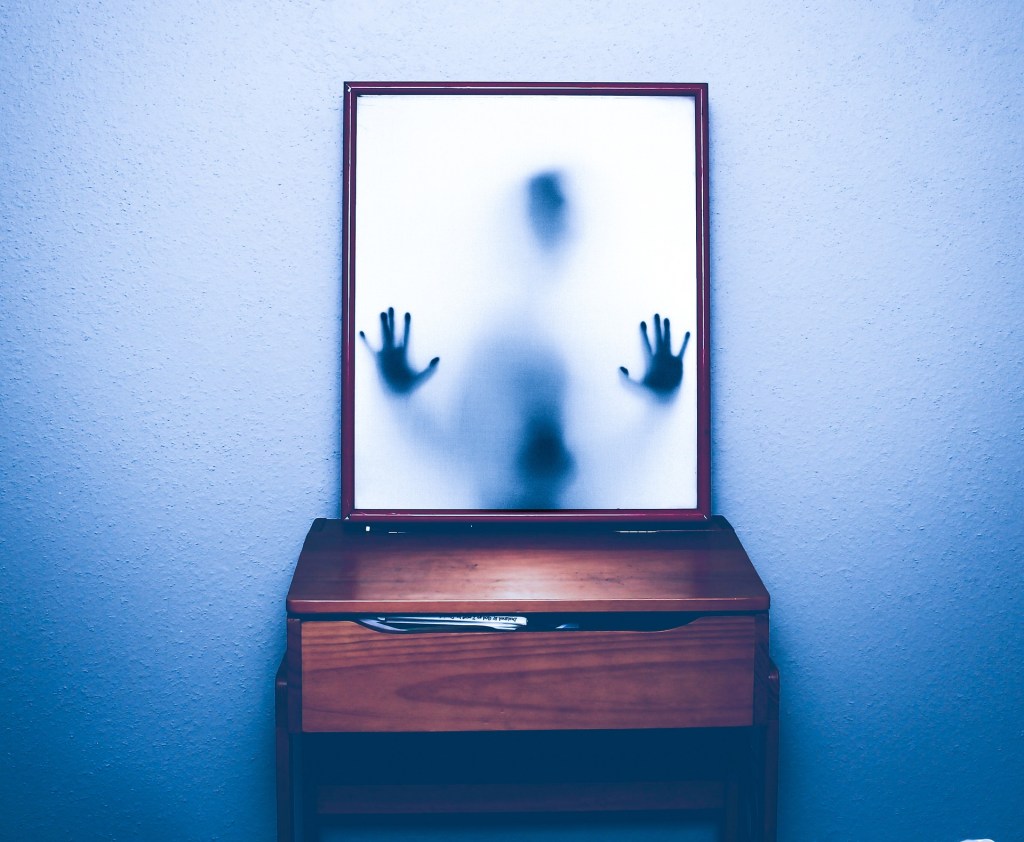
Her hair stood on end as she crept inside. There was something wrong with the mirror. At first Adie couldn’t make sense of what she saw. There was a strange crosshatching over the surface of the glass, so thick in places that it almost looked frosted. It covered the entire surface of the mirror, top to bottom and edge to edge. It took her a moment to realize that the marks were scratches, gouged into the surface of the glass as if with a screw or a nail. They grew larger and wilder the farther down they went, until at the bottom they were a nest of angry gouges that took up half the mirror.
Adie reached out automatically to touch the glass. The scratches were quite deep, rough to the touch. It would have taken a lot of work– and a lot of anger– to produce them. Gradually her mind found patterns in the chaos– and then it all clicked into place. From top to bottom, side to side, the scratches spelled out the same two words, written over and over again until they culminated in a ragged scrawl across the bottom:
FUCK YOU FUCK YOU FUCK YOU FUCK YOU FUCK YOU
Something moved behind the glass, and drew Adie’s eyes to her reflection. The girl behind the mirror was almost hidden behind the destruction she had wrought, but it was clear that she was pleased with herself. She smirked at Adie, and mouthed two words. Though Adie could not hear them, she understood them clearly.
“I just don’t see how you did it,” Adie’s mother said the next Saturday. “You were only up there for an hour– some of those scratches were a quarter of an inch deep!” She was leaning against the kitchen counter, overseeing Adie’s punishment breakfast of cold cereal and milk. For Adie’s parents there were pancakes and coffee and fresh-squeezed orange juice. The smells in the kitchen were a glorious torture to Adie, who usually looked forward to Saturday breakfasts all week.
She watched wistfully as her mother sliced fresh cantaloupe and poured real maple syrup into a jug for the table. “I didn’t do it,” she muttered for the thousandth time.
“Then who did, Adie?” her mother snapped, clearly losing patience with Adie’s protestations of innocence. “Only you and I were in the house, and I promise you I didn’t carve ‘Fuck you’ all over your mirror. Are you suggesting that some criminal broke in and did it?” She looked as if she wanted to throw something.
Adie rather wanted to throw something, too. She shrugged, looking down at her plate. What could she say?
The new mirror for her bathroom was delivered within a week of the old one’s demise. Under her mother’s direction, Adie had cleaned and polished the bathroom to a sparkling sheen, and the air was heavy with the remnants of chemical vapors. The mirror itself was larger and more elaborate than the other one had been. It had a beveled edge where the other had been plain, and a border of frosted-glass roses that Adie wanted to run her fingertips over. She stole glances at the glass as her father installed it, and as her mother polished it to a brilliant clarity. There was nothing unusual in their reflections. Adie began to hope.
After dinner that night, she crept toward the bathroom with butterflies in her stomach. Once again she reached through the doorway first to turn on the light. New mirror or not, there was no way she would ever set foot in that bathroom without the light on. Across the flawless counter, she laid out her things: toothbrush, toothpaste, dental floss, mouthwash. Then she looked up.
For a long, still moment, Adie stared at her reflection, and the reflection stared back at her. Neither of them moved. Around them, the house was quiet. Downstairs she could hear the news, and over it her parents’ quiet voices. Nothing was out of the ordinary. She slowly let out the breath she must have been holding for ages. In the mirror, the girl let out a breath, too. The two of them smiled at each other, then reached for their toothbrushes.
But as Adie squeezed toothpaste on her brush, her reflection continued to smile. The smile grew until it was a savage grin, full of sharp white teeth much larger than Adie’s own.
Adie shrieked and leaped backwards. She hit the wall hard, and a towel rack jabbed into her back. The thing in the mirror shrieked, too, and then began to laugh. As Adie doubted her senses, the thunder of footsteps began coming up the stairs: her parents, coming to see what the matter was. Adie wanted to tell them to hurry, please, help her– but the thing in the mirror had wrapped its fist around the toothbrush in its hand, and was advancing towards the mirror. Adie covered her face just as the mirror shattered.
When her parents reached the bathroom doorway, they found Adie crouched amid a sea of broken glass, still covering her eyes and weeping hysterically. Of the thing in the mirror there was no sign– only a little flicker of motion in one of the shards of glass that littered the floor.
This time the mirror was not replaced. Instead, her parents began to talk about “special care” and “seeing a therapist” when Adie was around the corner. She barely heard them. She was too busy finding, to her horror, that reflections were everywhere. She caught glimpses of herselfin windows, in pot lids, in the blades of table knives. Though she kept her eyes lowered, and tried to avoid anything reflective, it always came to her, anyway: a flicker of motion where nothing was moving; a flash of teeth in the corner of her eye.
One night, as she was going up to bed, she paused in her bedroom doorway. Across from the door, next to the closet, was a full-length mirror that her mother had bought for her at a flea market years before. It was very pretty, with a carved wooden frame the color of oxidized copper. She had always loved it, but since the night the first mirror was defaced she had kept it well-covered. Now the sheet she’d hung over it lay on a pool on the floor, and the mirror stared back at her unguarded.
She was stopped by her reflection. It had grown pale and drawn from many nights without much sleep, and the skin under her eyes was so dark that it looked blue. Her hair was an unkempt mass, and her clothes were out of place: she never checked her appearance anymore. It was no wonder her parents had taken to talking about her in hushed voices from around the corner. The changes in her appearance startled even her.
Just as she remembered that she should probably look away, the girl behind the mirror stepped forward.
Adie was out the door and halfway down the hallway before she’d registered what had happened. She had just enough presence of mind to sneak back and yank the door closed. Something seemed to tug against it when it was almost shut, and she gasped and held back a scream as she wrestled it into place. When it was closed, she grabbed a handful of blankets from the linen closet, minced back across her doorstep, and pounded down the stairs as fast as her legs could carry her.
Her parents were in the kitchen, talking in low voices again. They stopped when they heard her go into the living room. “What are you doing, Adie?” her mother called, in that careful, sweet voice she’d taken to using when addressing Adie personally..
Adie spread the lightest blanket across the old tweed couch. “I’m sleeping down here tonight.” She’d given up explaining her actions; they never believed her explanations, anyway.
She heard a flurry of whispers. “Uh… all right, honey,” her father said. She heard him close his paper. “Good night.”
She stacked most of the throw pillows at one end of the couch, then spread the other blankets on top of them. As she curled beneath the covers in her makeshift bed, chairs scraped in the kitchen. A moment later, the kitchen light went out. Now the living room was black and infinitely vast, but Adie didn’t care: it was a familiar darkness, and felt safer than the compromised space that had been her room.
With her vision thus lost, Adie’s ears grew sharper. She listened as her parents climbed the stairs and continued down the hallway to their room. They were still whispering, as if they thought she didn’t know what they were talking about. Someone stepped on the creaking board outside her bathroom. She heard the hallway light click off, and the darkness around her deepened. A moment later, her parents’r door squeaked open and shut.
Now the living room was an alien wasteland, alive with black shadows that moved when she tried to see them. She pulled a blanket all the way over her head. It had the same vague odor of mothballs as everything else in the linen closet, although Adie’s family never used mothballs.
She tried to reassure herself that everything was safe. Her parents were probably still awake. They always sat up for a while after they’d changed into their pajamas, talking and reading and settling down to sleep. She could see the clean white light of their reading lamps in her mind’s eye, and could nearly hear the placid murmur of their voices. It made her feel a little better to remember that they’d hear anything out of the ordinary.
Then she remembered the menacing stare of the thing behind the mirror. It had come from the bathroom to her room so easily– had haunted the kitchen and the car and the corners of her mind. What was to stop it from traveling to her parents’ room, as well? Reassurance twisted into regret, and she wished that she could go and warn them.
The house grew very quiet, and into the silence there came a dream. Adie was walking, holding in her arms a long wrapped parcel: the mirror from beside her bed, safely covered once again in a sheet with little hearts all over it.
Something was thumping and thudding against the glass inside the parcel, struggling to get out. There was a sour, unhealthy smell coming from the sheet. Adie knew that if she didn’t lock the mirror away it would get her, and then maybe it would assume her face and go and kill her parents, too. She tried to shoulder open the sliding door of her closet, and as she did so fingers rose from beneath the sheet and began to pinch at her arms and shoulders through the cloth. She screamed, and shuddered, but at last the door slid open.
“You are nothing,” hissed a voice inside her ear, just as she was wrestling the mirror inside. “You are food.” Sharp teeth bit into her neck just as Adie hurled the mirror into the corner. She heard it crack, and saw the sheet start to fall. Heart pounding, she leaped backwards and dragged the door shut just as something began to emerge from the shower of broken glass.
For a moment, there was silence. Then something began to scrabble against the door.
Adie screamed herself awake– and then was not sure she’d woken up at all. She lay paralyzed in the darkness, soaked in sweat, listening desperately for some sign that what had happened wasn’t real. All around her there was breathing: sharp, harsh, desperate, as if the lungs of an animal had been ripped from its body and left to die on their own. Her heart pounded against the inside of her chest.
Gradually the breathing slowed, and Adie finally realized that it had been hers all along. The last black shreds of the nightmare soon lost substance and fell away. Adie realized that she was still curled up beneath a nubbly, scratchy blanket that smelled vaguely of old mothballs, on a couch that under usual circumstances she’d get in trouble for sleeping on. She was in the living room, not in her bedroom at all, and nowhere near the mirror or the closet into which she really should have put it earlier.
Her mouth felt like it had been wiped out with cotton balls. She swallowed, but couldn’t get rid of the sour taste that lingered in the corners. Taking one last, deep breath, she pulled the blanket off her face. Cool air rushed over her skin, drying her sweat and giving her goosebumps. Adie peered into the darkness, trying to assure herself that nothing was amiss.
The house was dark and still, and around it the neighborhood was silent. Even the crickets weren’t chirping. It had to be late– maybe three or four in the morning, she thought. She turned over uneasily, meaning to go back to sleep, but quickly realized that she quite desperately needed to pee.
For a split second she thought of waiting tilll morning. The house was vast and black and chilly, and in her nest of blankets she felt relatively safe. The pressure on her bladder, however, was too powerful to ignore, and at last Adie relinquished her safety and staggered wearily to her feet.
Clumsy with sleep, she toddled towards the bathroom. The hardwood floor was chilly under her feet. She wished she’d thought to bring sleep-socks. From the kitchen she heard the hum and groan of the refrigerator, the rattle of ice falling into the machine. Outside the kitchen window, a bright streetlight showed that no strange shadows were lurking in the street. Everything appeared normal.
It wasn’t until Adie had almost reached the bathroom that she remembered: Her bathroom might have no mirror anymore, but this one most definitely did.
Frost crept up her spine as she stared through the pitch-dark doorway. She almost retreated right then and there, but she knew that she’d never be able to wait until morning. A brief thought of going back upstairs was quashed by the memory of what she’d seen in her room. Downstairs it was.
Anyway, if the thing was in her bedroom now, then maybe it hadn’t come downstairs yet.
Somewhat cheered by this thought, she reached through the doorway and turned on the bathroom light. Its cheerful yellow beams spilled into the hallway, shrinking and clarifying everything they touched. Now she could see that the bathroom was, after all, just a bathroom. There was the striped wallpaper that her parents had picked out together. There were the gleaming brass fixtures her mother had shined, and the white tile floor that her father had laid down one sweaty afternoon a few years before. There was an unlit purple candle among the bath towels on a shelf above the toilet, and it filled the room with the faint mixed scent of lavender and roses.
Just to be on the safe side, she kept her eyes lowered as she stepped quickly past the mirror. Nothing flickered in the corners of her eyes, and nothing hissed or muttered as she raised the toilet lid and sat down on the icy seat. She concluded her business without incident and got up to wash her hands.
A morbid curiosity compelled her to look up this time. She raised her eyes fearfully to her reflection– but there seemed to be nothing to fear. She saw only herself– the same old Adie, frizzy hair and awkward nose and all. She smiled, and her own shy smile came back. When she lifted her arms, the reflection’s arms went up, too. She did a little dance, and the mirror mirrored it without a trace of mockery.
The thing must have been somehow confined to the upstairs– or maybe she’d even defeated it when she’d trapped it in her dream. Tomorrow she would ask her dad to take the mirror out of her room. Maybe a priest could even come to bless the house– she’d ask her mother about it.
Adie grinned at her reflection, happy that the end was in sight.
Her reflection grinned back, and turned off the light.
Fran and I often have trouble choosing what to watch. She’s seen almost everything, for one thing, and I hate making her rewatch things. The overlap in our tastes also isn’t that wide, so it can be difficult finding something we both enjoy. Last week I randomly picked Midnight Mass, though, and it turned out to be a very good choice.
To make it clear: we are not horror fans. I walked out of IT about ten minutes in, and my attempt at watching Ju-On ended after ten seconds. We’ve both been curious about The Haunting of Hill House, also by Mike Flanagan, but we weren’t together when it came out and neither of us wanted to watch it alone. (Maybe now we’ll try.) Jump scares are the real issue, at least for me. I feel them like a physical assault, and that’s not a feeling I want in my entertainment media. Fortunately, Midnight Mass doesn’t have too many,, and the ones it has are for dramatic effect, so I didn’t mind them too much. Overall, it’s a beautiful series, with great acting, wonderful music, and gorgeous cinematography.
SPOILERS below, for obvious reasons.
We start with Riley Flynn. While driving drunk, he causes an accident that kills a teenage girl and is sent to prison for four years. The story begins when he comes home to the dying fishing community of Crockett Island. At the same time, Erin Greene, Riley’s childhood friend and sweetheart, has come home pregnant from a bad marriage. She’s settling into life as a single mom-to-be, taking her own mother’s place as the island’s only teacher. At the same time, Sheriff Hassan, one of two Muslims on the island and a recent transfer from New York City, is trying to build a meaningful life in a small, hostile town where there’s nothing much to do. His son resents him for bringing him here, and both are generally made to feel like outsiders. Meanwhile, the island’s few teenagers do their best to keep themselves sane in a place where nothing interesting has happened in years.
Then something does happen: to the shock of everyone in the congregation of St. Patrick’s, the local Catholic church, a new priest has come to fill in for the old priest, Monsignor Pruitt, who supposedly fell ill on his return from a pilgrimage to the Holy Land. The new priest, Father Paul, is very good at his job: kind, charismatic, and a talented preacher. Everyone seems to like him, and attendance at mass is going up. Good things are happening, relationships are forming, upswing, and the community as a whole seems to be on an upswing.
At the same time, though, some pretty nasty things are happening, too. (Content warning, if you’re thinking of watching this show: there are lots of animal deaths, including one very graphic one that’s extremely awful.) Father Paul seems to know more than he should, and in general there seem to be lots of secrets for an island with 127 people on it.
Then a genuine miracle happens at St. Patrick’s, and suddenly the mood changes.
I won’t completely spoil the rest, but I will say we were just a hair disappointed by the revelation of what’s actually happening in town: the truth wasn’t quite as mysterious and strange as the first episodes suggested. But it was a really neat twist on the trope.
The priest (played by Hamish Linklater) was a cool character: earnest, devoted, well-meaning, and tragically misguided. The congregation was also mostly devoted and well-meaning (though, critically, not all of them were) and I thought the director did a good job showing the positives and negatives of deep religious faith. Mike Flanagan apparently grew up Catholic and is now atheist, and you can definitely see that in this series. The incorporation of religious music is very effective, and it’s neat how key moments of the story are set at key points during Holy Week, building up to a catastrophic midnight mass on the eve of Easter Sunday where everything finally goes down.
The final scene of the show is really beautiful, and it’s a great callback/final summation of all those religious themes, with what felt like a reenactment of some of the earliest days of Christianity. It was clearly very deeply thought through, and really effective. Addiction, the show’s other main theme, was really well dealt with, treating the subject with both honesty and compassion. The series also has things to say about life in a small, traditional, dying community. The depiction was really strong, but if it had been possible, I would have liked to see just a tiny bit more of Crockett Island before everything went to pieces. I’m not even sure what state it’s supposed to be–Maine, maybe? It’s not important, I guess, but it would have been nice to know a little more about some of the extras who died horrifically during the course of the show.
One of the strongest points of the series was Bev Keane, played by Samantha Sloyan. She was a fantastic villain in that I absolutely hated her from moment one. Well done. She’s a kind of person who feels very familiar, though I can’t think of specific examples: a judgmental zealot who resents all the sinners around her for having a good time, and who can’t understand why everyone seems to be happier than her when she’s following all the rules and they’re not. There was some interesting little-girl imagery her portrayal (hair in a single braid down her back, Peter Pan collars, a high-necked white dress for mass, and a general air of “malicious tattletale” attitude”) that shows you she’s always been like this. Having never matured emotionally past “teacher’s pet,” she has no real depth of soul and isn’t able to understand genuine human relationships. There’s a brief moment at the end where she seems to have gained a hint of maturity, but (spoiler) it doesn’t last. It was a really compelling performance and added a lot to the show.
Sheriff Hassan (Rahul Kohli) was another strong performance, though I would have liked to see just a little more of him throughout the series. I loved his relationship with his son and the way the show dealt with the issue of religious conversion and intergenerational culture gaps, plus the irony of Hassan bringing his son to Crockett Island for safety in the context of what actually happened. I would have liked to have gotten a bit more backstory earlier in the series, because I felt like his big monologue (episode 6, I think?) tried to push too much info into too little space, but Kohli is a great actor and did an excellent job.
Riley (Zach Gilford) was probably my favorite performance. I absolutely loved him. Remorse shone through every moment, every gesture, and every word he said, and the dream images of Tara Beth were incredibly vivid and effective. I absolutely understood what he had gone through, where he was coming from emotionally, and why–after being gutted by the guilt of accidentally killing an innocent human being–he would make the choice he did rather than live through that again. The AA meetings between him and Father Paul were some of my favorite scenes. Another of my favorite characters was Joe Collie, a distorted reflection of Riley, who was also incredibly well acted (I would like to see more of Robert Longstreet).
Erin Greene, probably the main female character, was not my favorite. She was… fine… but her line delivery was a little too theatrical for me, and her big final monologue went on for WAY too long. But the actress, Kate Siegel, is apparently the director’s wife, so I guess I should get used to her if I’m going to keep watching Flanagan shows. I did love the relationship between Erin and Riley, though (from the beginning to the end). Another strong note was how Riley and his parents kept trying and and half-succeeding at reconnecting with each other throughout the story after the physical and emotional rift caused by what Riley did.
The show did have a few downsides. My main pet peeve was the lighting: though the show was set during early spring, the constant darkness and general color palette kept making me think it was October. There really is a difference between spring and autumn light, and in a series where so much of the action happens outdoors, I think that should have been taken into account. (Just looked it up and apparently it was filmed in fall because of COVID, which is understandable but unfortunate. I think it would have been better to wait a few more months.) I also felt that the last two episodes of the show were weaker than the first five (possibly because of who was missing). Overall, though, it was a really good series and I definitely recommend it.
I’d like to watch other shows and films by Mike Flanagan, but I’m worried they’ll be too scary. The Haunting of Hill House is one of my favorite books (I reread it almost every autumn), so I’m definitely interested in that adaptation. I’d also like to see The Fall of the House of Usher when it comes out, since we read that story in high school. I’d like to read The Turn of the Screw before I tackle The Haunting of Bly Manor (which is based on that book), so I’ll put that one off for a while. What spooky, creepy, pretty, and not-too-scary horror shows and movies would you recommend?









 Katherine Traylor